
AI Tools Introduction
This workshop is a very short introduction to AI tools that may speed up your every day life as a researcher. The field is moving fast and what is relevant/true today may not be tomorrow. The aim is to give an overview of things you might try, and to give you the confidence to continue exploring on your own.
This workshop is specifically about using Generative Artificial Intelligence (GenAI), or large language models (LLMs) to speed up common tasks of a researcher. It is mainly focused on how to use these tools for scientific coding. There are many other applications of AI to scientific research that are not covered here!
Teach the controversy
Many people – whom I respect – are against using GenAI tools in their scientific research. Academia is somewhat of an outlier here.
Nick Lyon (LTER LNO data analyst) perspective on AI tools
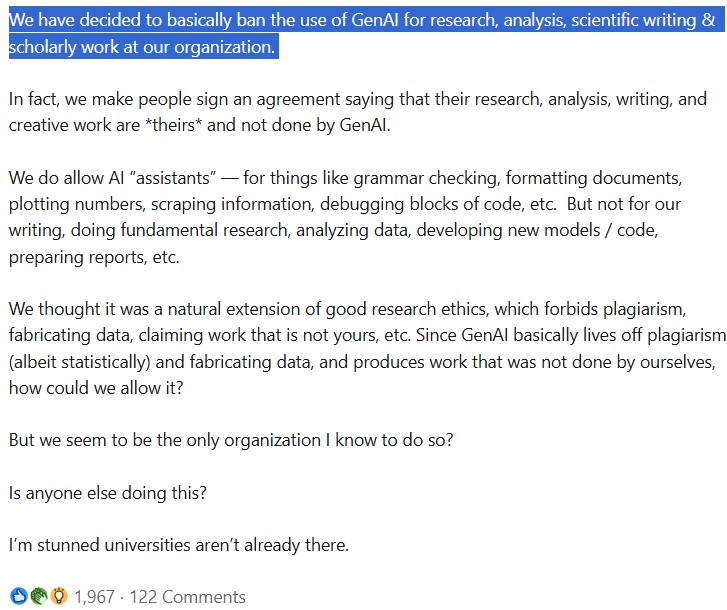
Jonathan Foley (Executive Director, Project Drawdown) perspective on AI tools
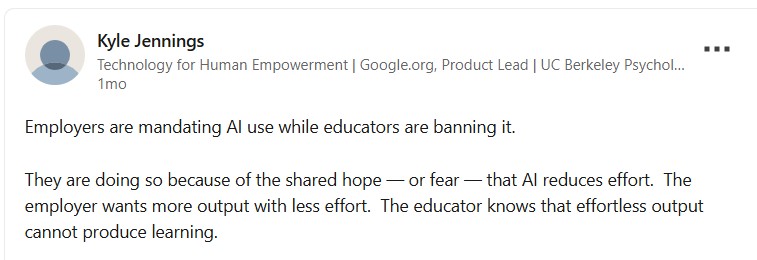
Kyle Jennings (Technology for Human Empowerment, Google.org) Employers are mandating AI use while educators are banning it.
My Opinion
- It is empowering to understand the tools available, the benefits and risks of use, and how to use them.
- AI tools are not a miracle; their work needs to be checked.
- Ethics demand that we disclose use of AI tools in our research.
- I use AI for coding but not for scientific writing.
Your Opinion
- ?
How I use AI tools in my work life
- Summarizing meeting notes or discussions
- Searching for academic papers (mixed success here)
- Coding
- Tweaking aesthetics - figures, this website, etc.
- Typeaheads (code completion)
- Data wrangling
- Turning scripts into functions
- Code review
- Coding in languages I don’t know fluently but can read (experimental/higher risk)